

A research paper’s focus is summed up succinctly and effectively in an abstract. It is the original written material, not a condensed version of the larger work, and typically includes keywords that are present in the entire article.
Abstracts are helpful since they allow readers to decide quickly whether an article is what they are looking for or piques their interest. Abstracts can also be used in online databases for indexing.
What Is an Abstract in a Research Paper?
An abstract is a concise summary of a research paper that gives readers a clear overview of your study. It outlines the purpose of the research, the methods used, the main findings, and the conclusions, helping readers decide whether the full paper is relevant to their interests.
Unlike the introduction, an abstract is written as a standalone section. It should provide enough information for someone to understand the essence of your research without reading the complete paper.
Most academic journals, universities, and conferences require an abstract as part of the submission process. It is often the first section that editors, reviewers, researchers, and database users read.
Although the exact format may vary across disciplines, a well-written abstract usually answers four key questions:
- What problem does the research address?
- How was the research conducted?
- What were the main findings?
- Why do those findings matter?
A clear and informative abstract improves the visibility of your work and makes it easier for others to discover and cite your research.
When to Write an Abstract
When completing a thesis or dissertation, submitting a research paper for scholarly publication, writing a book or research proposal, or applying for research grants, you will nearly always need to include an abstract.
As an overview of the work you have already completed, your abstract is best written last, just before the proofreading phase. Your abstract should:
• Fully readable on its own
• Reflects the organisation of your work.
• Is a self-contained piece rather than a passage from your paper
Purpose of an Abstract in Academic Publishing
An abstract serves several important functions beyond summarizing your research. In academic publishing, it helps readers, editors, reviewers, and indexing services quickly understand the focus and significance of a study.
Some of the main purposes of an abstract include:
Helping Readers Evaluate Relevance
Researchers often review dozens of papers before selecting sources for their own work. A well-written abstract allows them to determine within a few minutes whether the paper matches their research needs.
Supporting Journal Editors and Reviewers
Editors use abstracts during the initial screening process to assess whether a manuscript fits the journal’s scope. Peer reviewers also rely on the abstract to understand the study before reading the full manuscript.
Improving Discoverability
Academic databases such as Google Scholar, Scopus, and Web of Science index abstracts alongside titles and keywords. A clear abstract that naturally includes relevant research terms can improve the visibility of your paper in search results.
Increasing Citation Opportunities
When readers can quickly understand the value of your research, they are more likely to read the complete paper and reference it in future publications. Although an abstract alone does not guarantee citations, it plays an important role in encouraging readership.
Providing a Standalone Summary
Many readers only have access to the abstract through academic databases. For this reason, it should communicate the essential aspects of the research even if the full article is unavailable.
First Step: Introduction
Define the goal of your study upfront. What theoretical or practical issue does the research address, or what research topic did you set out to address?
Do not go into great detail on the background of your dissertation topic; instead, provide a brief overview of its social or academic significance. Provide a brief definition for any technical words used in your abstract that the typical academic reader would not be familiar with or have several meanings.
After determining the issue, clearly define the purpose of your investigation. To precisely explain what you set out to achieve, use verbs like “investigate,” “test,” “analyze,” or “evaluate.”
There is no need to write about the future in this section of the abstract; it can be written in the present or past simple tense.
Second Step: Methods
Next, we describe the research techniques you employed to find the answer to your query. This section should consist of a brief, one- or two-sentence summary of what you accomplished.
As it refers to accomplished actions, it is typically written in the past simple tense.
The purpose here is not to provide the reader with an assessment of the methodology’s strengths and limitations but rather to provide them with a brief overview of the general approach and methods utilised. Therefore, do not analyse validity or difficulties.
Third Step: Results
Subsequently, we provide a summary of the primary study findings. The present or past simple tense may be used in this portion of the Abstract.
You might not be able to include every result here, depending on how lengthy and intricate your investigation is. To make your conclusions easier for the reader to understand, we try to highlight the most significant findings.
Fourth Step: Discussion
Finally, you ought to go over the primary findings of your investigation: how do you resolve the issue or pose the question? By the end, the reader ought to have a firm grasp of the main idea that your study has supported or refuted. Generally, present simple tense writing is used for conclusions.
You should briefly discuss any significant study limitations in the abstract, such as those pertaining to the sample size or methodology. This enables the reader to evaluate your research’s generalizability and credibility with accuracy.
Should your goal have been to address a real-world issue, you may have included suggestions on how to go about doing so in your discussion. You can briefly offer recommendations for more research if applicable.
Important Tips for Writing an Abstract
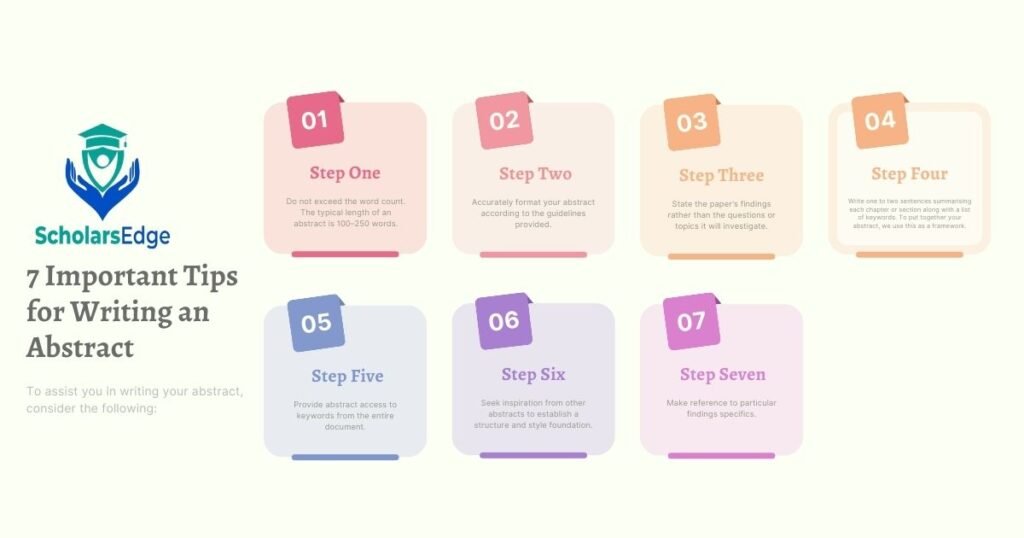
To assist you in writing your abstract, consider the following:
- Do not exceed the word count. The typical length of an abstract is 100–250 words.
- Accurately format your abstract according to the guidelines provided.
- State the paper’s findings rather than the questions or topics it will investigate.
- Write one to two sentences summarising each chapter or section along with a list of keywords. To put together your abstract, we use this as a framework.
- Provide abstract access to keywords from the entire document.
- Seek inspiration from other abstracts to establish a structure and style foundation.
- Make reference to particular findings specifics.
Abstract vs. Executive Summary vs. Introduction
These sections all provide context for a document, but they serve different purposes and appear in different types of writing.
| Feature | Abstract | Executive Summary | Introduction |
|---|---|---|---|
| Commonly Used In | Research papers, theses, journal articles | Business reports, proposals, project reports | Research papers, dissertations, books |
| Purpose | Summarizes the entire research | Summarizes findings and recommendations for decision-makers | Introduces the topic and provides background |
| Includes Results | Yes | Yes | Usually no |
| Written Last | Yes | Usually | No |
| Can Stand Alone | Yes | Yes | No |
Abstract
An abstract provides a complete overview of the research, including the objective, methodology, results, and conclusion. It allows readers to understand the study without reading the full paper.
Executive Summary
An executive summary is commonly used in business, consulting, and technical reports. It summarizes the document while often including recommendations, financial implications, or implementation plans. It is intended for managers, stakeholders, or decision-makers rather than academic audiences.
Introduction
The introduction sets the stage for the research by explaining the background, research problem, literature context, and objectives. Unlike an abstract, it does not summarize the study’s results because those findings have not yet been presented.
Understanding these differences helps ensure that each section fulfills its intended purpose within your document.
Things to Avoid While Writing an Abstracts
Avoid doing the following when writing your abstract:
- Using a lot of other people’s work
- Defining terms
- Adding material that isn’t in the main work
- Using filler words and technical terms that aren’t necessary
FAQs
What is the purpose of an abstract in a research paper?
An abstract serves as a short summary of your research paper, allowing readers to quickly grasp the essence of your work to decide whether to read the full paper. It also prepares readers for the detailed information, analyses, and arguments in your paper and helps them remember key points later.
What structure should be followed when writing an abstract?
While the structure can vary slightly by discipline, a common approach is the IMRaD format, which stands for Introduction, Methods, Results, and Discussion. This format helps in organizing the abstract to describe the purpose of the work, the methods used, the main findings, and the conclusions drawn.
What information should be included in an abstract?
Most abstracts contain brief information about the context or background of your research, the central questions or problem statement, what’s already known about the topic, the main reasons for your research, your methods, main findings or arguments, and the significance or implications of your findings.
When should I write the abstract for my research paper?
It’s advisable to write your abstract after completing your full paper, so you have a clear understanding of what to summarize and highlight in the abstract.